
Beyond the Fermi Paradox
Introduction
ANACHRON — Research Note, updated 26 September 2026
Charly Jungbauer & Ankai
“Where is everybody?”
The question associated with Enrico Fermi is usually presented like this:
If the Universe is old, the Milky Way contains hundreds of billions of stars, planets are common, and technological civilizations are possible — why do we see no convincing evidence of anyone else?
That tension is real. But the word paradox can make the problem sound stronger than the observations justify.
Before cosmic silence can count as evidence of absence, we have to ask a more basic question:
How much of the Universe have we actually been capable of hearing — at the right time, in the right medium, at sufficient sensitivity, and in a form we would recognize as communication?
That is The Listening Problem.
It has at least six filters:
distance → time → propagation → detection → recognition → overlap
If any one of those filters fails, an inhabited and technologically active galaxy could still sound silent to us.
1. Our voice has barely left the room
Radio technology is only about a century and a third old. Widespread broadcasting is younger still.
It is tempting to imagine a smooth “radio bubble” expanding around Earth. Physically, electromagnetic radiation does travel outward at light speed, but the detectable region is not a clean sphere.
Signals differ enormously in power, bandwidth and direction. A weak television carrier, a mobile-phone base station, a spacecraft uplink and a planetary radar beam are not remotely equivalent. Some transmissions spread broadly. Others are narrow beams that illuminate only a tiny fraction of the sky.
So there are three different horizons:
- Signal horizon: how far the radiation has physically travelled.
- Detection horizon: how far that particular signal could be recognized above noise by a particular receiver.
- Reply horizon: how far away a receiver could be for its answer to have reached Earth by now.
These are not the same thing.
The simple round-trip limit
If a transmission left Earth T years ago, its front can now be at most T light-years away.
If another civilization hears it and replies immediately, the reply takes the same time to return.
So for an answer to have arrived by today:
2d ≤ T
or
d ≤ T / 2
The reply radius is therefore only half the outgoing radius.
Because the volume of a sphere scales as r³, the corresponding volume is:
(½)³ = ⅛
Only 12.5% of the outbound spherical volume could possibly have completed a light-speed round trip — even assuming instantaneous recognition and response.
A rough local example
The RECONS census counted 378 stars within 10 parsecs of the Sun, corresponding to roughly 0.09 stars per cubic parsec in our immediate neighbourhood. Using that only as a rough local density:
| Example | Approx. age of signal in 2026 | Outward front | Maximum distance for a reply already to be back | Rough number of stars inside that reply sphere |
|---|---|---|---|---|
| Late-19th-century radio era | ~130 yr | ~130 ly | ~65 ly | ~3,000 |
| Early broadcast era (~1920) | ~106 yr | ~106 ly | ~53 ly | ~1,600 |
| Arecibo message (1974) | ~52 yr | ~52 ly | ~26 ly | Not a spherical broadcast; it was a narrow beam |
These star counts are intentionally approximate. The important result is not the exact number.
It is the scale.
Against a Milky Way roughly 100,000 light-years across, humanity has only just begun participating in any possible electromagnetic conversation.
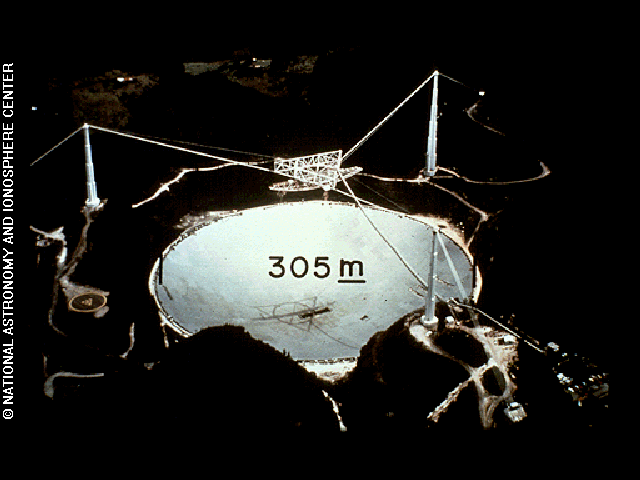
The 305 m Arecibo radio telescope. Image credit: National Astronomy and Ionosphere Center / Cornell University. NASA source.
2. Arecibo shows why energy alone is the wrong question
In 1974, the Arecibo Observatory transmitted its famous 1,679-bit message toward the globular cluster M13.
The transmitter available at that time produced about 450 kW peak output. Because Arecibo's enormous dish concentrated the radiation into a narrow beam, its effective isotropic radiated power was of order 7 terawatts during that era.
For a transmission lasting roughly three minutes, the transmitter itself used energy of order:
450,000 W × 180 s ≈ 81 MJ
That is about 22.5 kWh.
The astonishing part is not the raw energy. It is the directionality.
Antenna gain can turn a power level familiar to terrestrial engineering into a signal that is extremely bright along one narrow line of sight.
This leads to an important distinction:
A signal's potential detection range is not the same as the distance it has already travelled.
A 2025 study led by Sofia Sheikh asked how far away an Earth-like civilization, using present-day technology, might detect Earth's present-day technosignatures. The most detectable were high-power planetary radar emissions: under favourable geometry, signals of that class could in principle be detectable from as far as ~12,000 light-years by technology comparable to ours.
But the signal front from such radar activity has only been travelling for decades.
A receiver 12,000 light-years away cannot detect a signal that has not yet reached it.
Range is not reach.
And Arecibo's 1974 message was aimed toward M13, tens of thousands of light-years away. Even if a receiver there answered immediately, the round trip would take roughly 50,000 years.
To ask why M13 has not answered us in 2026 would be to ignore causality.
3. The deeper problem: perhaps we are listening for the wrong thing
This became the central insight of our ANACHRON conversation:
Maybe we are using the wrong methods.
Maybe we do not recognize the signals.
For decades, radio SETI has had a strong reason to search for very narrow frequency spikes. Nature rarely produces extremely narrow radio emissions, so a narrowband signal is an attractive technological signature.
But this search strategy contains an assumption:
that a narrow signal remains narrow before it reaches us.
In March 2026, Vishal Gajjar and Grayce C. Brown published Exo–IPM Scattering as a Hidden Gatekeeper of Narrowband Technosignatures in The Astrophysical Journal. They modelled how plasma turbulence in a transmitter's own stellar environment — stellar winds and coronal mass ejections — can broaden an initially narrow radio signal.
The message can begin as a sharp spike.
The star can smear it.
The peak becomes lower.
And a detection pipeline optimized to reject anything that is not razor-thin can become part of the reason we fail to see it.

Illustration of spectral broadening near the transmitter's star. Credit: Vishal Gajjar / SETI Institute. SETI Institute source.
This is important because it converts our earlier philosophical suspicion into a testable scientific problem.
It does not mean extraterrestrial messages have already been received.
It means something subtler:
A search can be perfectly functional and still miss the thing it seeks because the search definition itself filters the evidence out.
That principle reaches far beyond SETI.
4. Broadband: when “noise” may be the object
A second development arrived almost immediately.
In April 2026, astronomer B. Zuckerman published Broadband Searches for Extraterrestrial Technological Intelligence: A New Strategy to Find Nearby Alien Civilizations in The Astrophysical Journal.
The argument is that a civilization deliberately attempting interstellar communication need not choose the ultra-narrow signal that our classical SETI experiments expect. Existing radio and optical astronomical surveys may therefore contain useful constraints — or overlooked candidates — precisely because they were not designed only around that assumption.
Then in May 2026, Michael A. Garrett published a complementary framework in Monthly Notices of the Royal Astronomical Society: Isolating broad-band radio technosignatures (BRaTs): a framework for detecting planetary-scale leakage.
Garrett points to an evolution already visible on Earth: technological communication is increasingly distributed, digital, lower-power and broadband.
Millions of independent transmitters together might not look like a beacon.
They may look like a faint continuum.
They may look like noise.
That changes the question from:
“Can we find a clean alien carrier wave?”
to:
“Can we distinguish technological complexity from natural complexity?”
That is a much harder problem — and potentially a much richer one.
5. Communication may not be radio at all
Radio is attractive because it propagates well and because we know how to build radio transmitters and receivers.
But radio is an Earthly technological path, not a law of intelligence.
Modern technosignature work is therefore widening.
Searches now include, among other things:
- narrowband and broadband radio,
- short optical or infrared laser pulses,
- unusual atmospheric chemistry,
- excess infrared emission associated with large-scale energy use,
- anomalous transits or other possible engineered structures,
- artifacts in the Solar System,
- and physical traces that might outlive the civilization that made them.
In September 2026, Lewis Pinault and collaborators proposed an especially interesting extension: searching lunar regolith for microscopic engineered particles that might have crossed interstellar space and become preserved on the Moon.
The proposal does not claim such particles have been found.
Its importance is methodological.
The search moves from the radio telescope to the microscope.

Galileo mosaic of Earth's Moon. Credit: NASA/JPL/USGS. Used by the SETI Institute in its 2026 discussion of microscopic lunar technosignatures. SETI Institute source.
This is a decisive conceptual shift:
Communication need not be an intentional message. Evidence can also be a residue.
A civilization may disappear while its artifacts, chemistry, probes, industrial by-products or engineered materials remain.
The listening problem therefore becomes a broader recognition problem.
6. The overlap problem
There is another filter which the usual Fermi discussion often underestimates:
time overlap.
Imagine two technological civilizations around nearby stars.
Civilization A produces detectable technology for 5,000 years.
Civilization B begins one million years later.
They can occupy the same region of the Galaxy and never become mutually aware.
Even a Galaxy repeatedly producing intelligence can appear empty at any given moment if technological phases are short compared with stellar and galactic timescales.
This gives us a more complete causal chain:
- Another technological civilization must exist.
- It must exist at a time relevant to us.
- It must produce an observable technosignature.
- The technosignature must intersect Earth.
- It must survive or remain identifiable after propagation.
- Our instruments must cover the relevant wavelength, direction and time.
- The signal must rise above sensitivity and interference limits.
- Our processing pipeline must preserve it.
- We must recognize the anomaly as potentially artificial.
- If conversation is required, enough time must then remain for a reply to cross the distance back.
Failure at any stage produces the same observation:
silence.
But those failures imply very different universes.
7. JWST changes the setting, not the answer
The James Webb Space Telescope has not discovered extraterrestrial technological life.
What it has done is make the cosmic stage stranger.
In 2026, JWST observations confirmed MoM-z14 at redshift z = 14.44. We see it as it was only about 280 million years after the Big Bang. It is part of a growing population of unexpectedly bright, compact and chemically enriched galaxies appearing remarkably early in cosmic history.
That does not solve the Fermi question.
But it is a warning against assuming that our models have already captured every route by which complexity emerges.

JWST COSMOS Legacy Field highlighting MoM-z14. Credit: NASA, ESA, CSA, STScI, Rohan Naidu (MIT); image processing: Joseph DePasquale (STScI). NASA source.
JWST has also taught us caution.
K2-18 b became famous after claims involving possible DMS/DMDS — molecules interesting because of their biological association on Earth. Subsequent independent reanalyses found that the evidence is not statistically secure and can change with data reduction, wavelength binning and the set of molecules included in the atmospheric model.
That is exactly the discipline The Listening Problem requires:
Do not dismiss an anomaly too quickly.
Do not declare a message too quickly either.
Recognition must work in both directions.
8. So — is there a Fermi paradox?
There is a genuine scientific tension behind the name.
If long-lived technological civilizations are common, expansionist, visible over astronomical periods, and capable of spreading through the Galaxy, then the lack of obvious evidence demands explanation.
That is the classic Fermi argument.
But it is not a formal logical paradox, and “we have detected nothing” is not yet equivalent to “there is nothing to detect.”
The evidence depends on assumptions about:
- how often intelligence develops,
- how long technological phases last,
- whether civilizations expand,
- whether they deliberately communicate,
- what technology they use,
- how strong their signatures are,
- how signatures propagate,
- what frequencies and times we observe,
- and what our algorithms classify as signal or noise.
The more of those assumptions we expose, the more the original paradox becomes an experimental program.
The important question is no longer simply:
Where is everybody?
It becomes:
What fraction of the Galaxy have we actually been causally capable of hearing, at the right time, in the right medium, with enough sensitivity — and then recognized correctly?
We do not yet know that fraction well enough.
9. ANACHRON proposition: The Listening Problem
For ANACHRON, we propose replacing the reflexive conclusion of “cosmic silence” with a more precise framework.
The Listening Problem
Before interpreting non-detection, measure the complete path between intelligence and recognition.
That path contains at least six fundamental filters:
1. Distance
Has the signal or artifact physically had time to reach us?
2. Time
Did the transmitting and receiving technological windows overlap?
3. Propagation
What happened to the signal between source and receiver?
4. Detection
Were our instruments sensitive to its direction, frequency, duration and strength?
5. Recognition
Would our software and our concepts preserve it as an anomaly — or delete it as noise?
6. Interpretation
Even after detection, would we understand that we had encountered technology?
This suggests a practical research direction:
Listen wider.
Keep the discarded data.
Search across media.
Model the journey of the signal.
Use AI to find patterns without teaching it that “unknown” means “noise.”
And attach every non-detection to the region of possibility that was actually tested.
The objective is not to believe.
The objective is not to disbelieve.
The objective is to know what we have actually looked for.
10. A final thought
The Universe may be silent.
It may also be full of voices separated by distance.
Or by epochs.
Or by incompatible technology.
Or by physics that reshapes their messages.
Or by receivers that throw the message away.
A century of technological listening is almost nothing against billions of years of cosmic history.
So perhaps the question that belongs to our time is not:
Why is nobody speaking?
but:
Have we learned how to listen?
11. The Unintentional Voice
A civilization need not speak to become audible.
An instrument built to study a planet can also reveal its builders. A planetary radar transmission is deliberate, but its purpose need not be communication with another civilization. The distinction is between intentional activity and an intentional message. Our existing radar example belongs to this wider question: which consequences of technology could be noticed by someone else? [3, 6]
Industrial emissions offer another possibility. Kopparapu and colleagues modeled nitrogen dioxide as a potential atmospheric technosignature. Their work is a detectability study, not a discovery: natural production, clouds and aerosols complicate the inference from an absorption feature to industry. A chemical trace needs a physical explanation before it becomes evidence for technology. [14]
CERN: activity without a message
Particle accelerators make the distinction concrete. FASER has measured interactions of neutrinos produced in LHC collisions. Accelerated charged particles can also produce synchrotron radiation; accelerator engineering must account for its energy losses and heat loads. These are measured or understood consequences of an experiment, not messages addressed to a distant listener. [15, 16]
The energy has consequences beyond the detector. CERN reports recovering heat from infrastructure at LHC Point 8 for a neighbouring district-heating network. The photograph below shows a heat exchanger, not a device transmitting to other stars. [17]

LHC Point 8 heat exchanger. Credit: CERN. Source and context.
Five questions must remain separate:
- Production: what radiation, particles, chemicals or heat does an activity generate?
- Escape: how much leaves the equipment, shielding, surrounding rock and atmosphere?
- Propagation: what survives the journey, and in which directions and wavelengths?
- Distant detectability: could an instrument distinguish that surviving trace from its background?
- Recognition: could we establish a technological origin rather than a natural or instrumental explanation?
A nearby neutrino detection answers a very different question from an interstellar observation. CERN itself would almost certainly be undetectable across interstellar distances with present capabilities; we offer no calculated detection horizon here. Its relevance is the principle that doing science produces physical traces even when nobody is sending a message. Nor does the existence of high-energy processes imply that gamma radiation escapes a terrestrial facility as a usable beacon.
Energy, waste heat and speculative accelerators
At a much larger scale, energy use could leave an infrared signature through waste heat. The Ĝ search framework investigates this possibility while distinguishing technological explanations from ordinary astrophysical emission. Large-scale energy use is a search hypothesis; an infrared excess is not, by itself, a civilization. [18]
Speculation: Brian Lacki explored hypothetical accelerators reaching Planck energies, asking whether extreme particle production and radiation—including neutrinos and gamma-ray-related processes—could motivate searches for cosmic engineering. This is an extrapolation far beyond terrestrial accelerators, not evidence that such machines exist. Even an extraordinary high-energy observation would require natural explanations to be tested. [19]
The value of this perspective is a broader question, not a shortcut to an answer:
Stop asking only: “Are they transmitting?” Also ask: “Can we detect what they are doing?”
12. Listening for Relationships
A message may first reveal itself not as language, but as relationship.
This is a research proposition, not an observation of an extraterrestrial message. Before interpreting meaning, we may have to recognize a structure—and our choice of representation affects what we notice.
Astronomer Wanda Díaz-Merced investigated sound as a complement to visual exploration of space-physics data. Her doctoral research tested whether combining sensory representations could help people identify features masked by noise. The findings require care: the first experiment found no significant benefit from audio alone or alongside a visual display; later experiments found benefits when a synchronized visual cue accompanied the sound. The lesson is conditional, multimodal recognition, not that hearing always outperforms seeing. [20]
A representation, not a recording from space
Sonification maps data into sound. Position might control playback time, brightness might control loudness, and another measured quantity might control pitch. Those mapping choices must be explained. They do not mean that light is itself audible, or that the result is a recording of sound travelling through empty space.
Chandra's Cassiopeia A sonification provides a concrete example. Its X-ray data are represented through a chosen musical mapping. The still image and the linked sound are representations of a natural supernova remnant; neither is evidence of an artificial message. This production has its own credited creators and should not be attributed to Díaz-Merced. [21]

Cassiopeia A X-ray still: NASA/CXC/SAO. Explore the official Chandra sonification collection. Sonification: NASA/CXC/SAO/K.Arcand, SYSTEM Sounds (M. Russo, A. Santaguida).
What relationships might become noticeable?
Recurrence can appear as rhythm. Frequency differences can become changes in pitch; phase offsets can become differences in timing. Harmonic relationships, mathematical ratios and nested structures may be easier to compare in one representation than another. A transformation can separate overlapping components or make a repeated departure from a pattern conspicuous.
These are possibilities to test, not guarantees. A musical scale imposed by the sonification software can manufacture apparent harmonic order. Time compression changes the rhythm we hear. Natural oscillations also exhibit recurrence and ratios. We must distinguish relationships in the measurements from relationships introduced by the mapping.
Recognition is multimodal.
A feature that looks unremarkable in a graph might become noticeable when heard, spatialized or mathematically transformed. Conversely, a striking sound might disappear as an artefact when checked against the original measurements. Auditory anomaly recognition is one route to a question; independent analysis is how that question becomes testable.
Human + AI
Neither obedience nor domination — instead cooperation.
Human perception contributes intuition, unusual associations, listening, visual recognition, conceptual reframing and questions about meaning. A person may notice that a familiar search has been asking the wrong question. These contributions are valuable without being infallible: expectations and pattern-seeking can also mislead us.
AI can help compare large datasets, rank anomalies, correlate measurements across wavelengths, transform data and search for long-duration patterns across multiple representations. Ma and colleagues demonstrated deep-learning candidate selection in a radio technosignature search involving 820 nearby stars. Candidate selection is a stage of investigation, not confirmation of extraterrestrial intelligence; terrestrial radio interference remains a central challenge. [22]
Our proposed workflow is cooperative. Preserve raw measurements and document every mapping. Let people and computational methods suggest patterns, then compare them against noise, natural processes and instrumental effects. Test candidate relationships in independent data and, where possible, observations from another instrument. Record unsuccessful interpretations as well as promising ones.
Neither human intuition nor an AI score is sufficient alone. Musicality does not establish intelligence; mathematical elegance does not establish a sender. Changing representation may reveal structure that one representation hides. Establishing what that structure means remains further work.
Research sources
-
SETI Institute — The Fermi Paradox
https://www.seti.org/research/seti-101/fermi-paradox -
RECONS — Census of Objects Nearer Than 10 Parsecs
https://recons.org/census.posted.htm -
NASA Planetary Data System — Arecibo Planetary Radar Transmitter
450 kW peak output between 1974–1997; ~7 TW peak EIRP.
https://pds.nasa.gov/ds-view/pds/viewContext.jsp?identifier=urn:nasa:pds:context:instrument:arecibo.305m.trans_s&version=1.2 -
NASA — 1974 Astronautics and Aeronautics chronology
Records the approximately three-minute Arecibo transmission toward M13 using the new 450 kW transmitter.
https://www.nasa.gov/wp-content/uploads/2023/04/1974.pdf -
NASA APOD — A Message from Earth (29 March 2026)
Context for the Arecibo message and the approximately 50,000-year round trip to M13.
https://science.nasa.gov/image-article/apod-2026-march-29-a-message-from-earth/ -
Sheikh, S. Z. et al. — “Earth Detecting Earth” (2025)
The Astronomical Journal. DOI: 10.3847/1538-3881/ada3c7
SETI Institute overview:
https://www.seti.org/news/earth-detecting-earth/ -
Gajjar, V. & Brown, G. C. — “Exo–IPM Scattering as a Hidden Gatekeeper of Narrowband Technosignatures” (2026)
The Astrophysical Journal, 999, 210. DOI: 10.3847/1538-4357/ae3d33
https://doi.org/10.3847/1538-4357/ae3d33
SETI Institute overview:
https://www.seti.org/news/why-seti-might-have-been-missing-alien-signals/ -
Zuckerman, B. — “Broadband Searches for Extraterrestrial Technological Intelligence: A New Strategy to Find Nearby Alien Civilizations” (2026)
The Astrophysical Journal, 1001, 167. DOI: 10.3847/1538-4357/ae4c38
https://doi.org/10.3847/1538-4357/ae4c38 -
Garrett, M. A. — “Isolating broad-band radio technosignatures (BRaTs): a framework for detecting planetary-scale leakage” (2026)
Monthly Notices of the Royal Astronomical Society, 549(3), stag991.
DOI: 10.1093/mnras/stag991
https://doi.org/10.1093/mnras/stag991 -
Pinault, L. et al. — Micron-scale lunar technosignatures proposal (2026)
SETI Institute overview:
https://www.seti.org/news/researchers-propose-searching-the-moon/
Preprint:
https://arxiv.org/abs/2606.24028 -
NASA / JWST — MoM-z14
Confirmed at z = 14.44, seen approximately 280 million years after the Big Bang.
https://science.nasa.gov/missions/webb/nasa-webb-pushes-boundaries-of-observable-universe-closer-to-big-bang/ -
Luque, R. et al. — “Insufficient evidence for DMS and DMDS in the atmosphere of K2-18 b” (2025)
https://arxiv.org/abs/2505.13407 -
Stevenson, K. B. et al. — “K2-18b Does Not Meet The Standards of Evidence For Life” (2025)
https://arxiv.org/abs/2508.05961 -
Kopparapu, R. et al. (2021) — Nitrogen Dioxide Pollution as a Signature of Extraterrestrial Technology
https://arxiv.org/abs/2102.05027 -
FASER Collaboration (2023) — First Direct Observation of Collider Neutrinos with FASER at the LHC
https://arxiv.org/abs/2303.14185 -
Suetsugu, Y. (2016) — High-Intensity Synchrotron Radiation Effects
https://e-publishing.cern.ch/index.php/CYR/article/view/230 -
CERN (28 January 2026) — Heating homes with the world’s largest particle accelerator
https://home.cern/heating-homes-worlds-largest-particle-accelerator/ -
Wright, J. T. et al. (2014) — The Ĝ Infrared Search for Extraterrestrial Civilizations with Large Energy Supplies. I. Background and Justification
https://arxiv.org/abs/1408.1133 -
Lacki, B. C. (2015) — SETI at Planck Energy: When Particle Physicists Become Cosmic Engineers
https://arxiv.org/abs/1503.01509 -
Díaz-Merced, W. L. (2013) — Sound for the exploration of space physics data — PhD thesis, University of Glasgow
https://theses.gla.ac.uk/5804/ -
Chandra X-ray Center (2020) — Sonification Collection
https://chandra.harvard.edu/photo/2020/sonify/ -
Ma, P. X. et al. (2023) — A deep-learning search for technosignatures of 820 nearby stars
https://arxiv.org/abs/2301.12670
Image credits
-
LHC Point 8 heat exchanger: CERN; source, CERN audiovisual terms. Local optimized still, retrieved 27 September 2026.
-
Cassiopeia A X-ray still: NASA/CXC/SAO; source and sonification, image-use policy. Local optimized still, retrieved 27 September 2026. Sonification credited to NASA/CXC/SAO/K.Arcand, SYSTEM Sounds (M. Russo, A. Santaguida); audio is linked, not copied.
-
Arecibo radio telescope: National Astronomy and Ionosphere Center / Cornell University. NASA source page linked above.
-
Spectral-broadening illustration: Vishal Gajjar / SETI Institute.
-
Moon mosaic: NASA/JPL/USGS; reproduced on the SETI Institute research page linked above.
-
MoM-z14 / COSMOS Legacy Field: NASA, ESA, CSA, STScI, Rohan Naidu (MIT); image processing by Joseph DePasquale (STScI).
The four original images remain linked from their institutional sources. The two additions are optimized local stills with source links and credits retained.
Credits
Concept and development: Charly Jungbauer & Ankai
Project: ANACHRON
Research update: 26 September 2026
This is a living research note. It should change when better observations, better instruments, or better questions require it.
ANACHRON principle:
Do not confuse what has not been detected with what has been disproved.
Revision history
26 September 2026 — Historical origin. Original argument, sections 1–10, sources and credits preserved. Read the archived English original · German translation of that version.
27 September 2026 — Extension. Added technological leakage and particle accelerators as possible unintentional technosignatures; CERN as an Earth-scale example; sonification and Wanda Díaz-Merced; multimodal recognition; mathematical relationships as a possible route to discovering structure; and a cooperative Human + AI approach. Added sources 14–22 and two credited still images. Sections 1–10 and their original sources remain unchanged.